In response to
Venkatesh Rao's Blyg · Venkatesh Rao · “Regenerable Software: A Vision for Agentic Software Engineering V1 Draft, commen…” · item 0mrdcxtf673g97gytsm87a6mva, v1 · <https://venkateshrao.com/blyg/t/0mrdcxtf673g97gytsm87a6mva/> · retrieved Nov 25, 2026
Reply to: Regenerable Software: A Vision for Agentic Software Engineering
AI as a tool that allows selection pressure to act on code
Code is an expression of intent, but it is also a record of encounters with reality. A working system embodies both what its creators wanted and what they discovered along the way: awkward dependencies, unexpected user behavior, operational constraints, security threats, and failures that became visible only under particular conditions. Thus, the implementation is also a projection of the environment in which it learned to work. While intents and testing can encode some of it, the preferences behind them are not captured because they are diffused in the designer.
This gives an ecological dimension to agentic software engineering and might be the seed for Liveness proper.
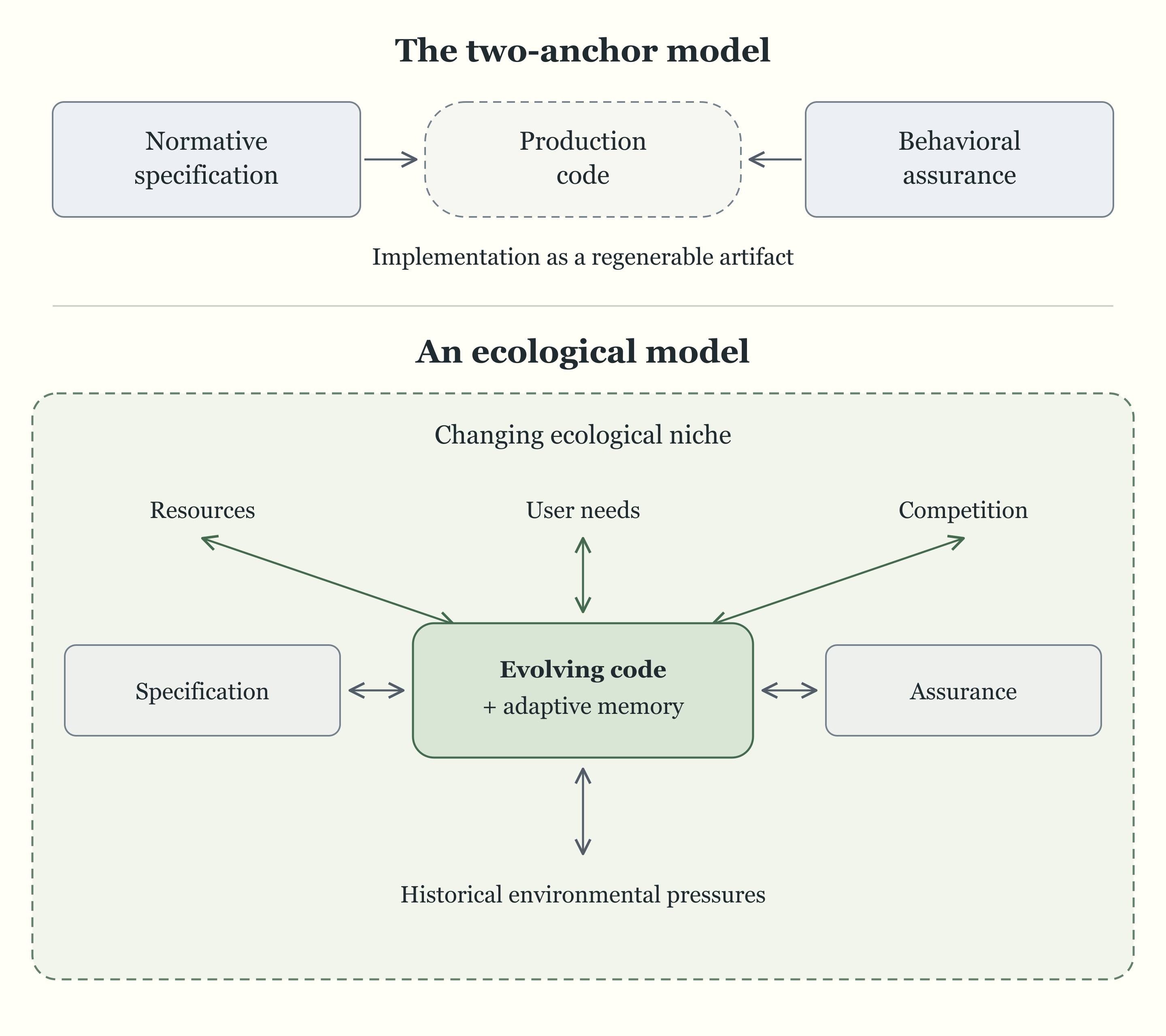
In his essay on regenerable software, Venkatesh Rao proposes that engineering intelligence can increasingly migrate into two durable anchors: normative specification, which establishes what software ought to do, and behavioral assurance, which establishes whether it does it. Production code can then become a replaceable realization of that knowledge. He also recognizes the difficulty: intelligence can remain trapped in implementations, creating regeneration debt, while specifications and verification retain blind spots. His conjecture is that, as the anchors mature, preserving the original production code should become progressively less necessary. Rao, “Regenerable Software.”
The ecological question concerns that trajectory. How much of a successful implementation’s adaptive knowledge can be extracted economically? And how quickly does new knowledge accumulate with a changing environment while we are extracting the old?
Madagascar offers a useful image. Its tenrecs — small, insectivorous mammals belonging to the family — include forms that resemble small mammals from other evolutionary lineages, including shrews and hedgehogs. Similar ecological demands can produce convergent features without erasing differences of ancestry and underlying construction. The resemblance is instructive, although research cautions against assuming that every dimension of tenrec diversity fits a simple story of adaptive radiation. Finlay and Cooper, 2015.
A niche constrains an organism without uniquely specifying its form. There are multiple ways to survive within a set of conditions, and the route taken matters. In software, the market and competitive forces are always willing to eat or starve a project.
So, software has something like a niche too. It draws resources from compute, data, money, distribution, and developer attention. It faces pressure from competitors, attackers, changing infrastructure, and obsolescence. Its continued usefulness depends on users whose habits, expectations, and work are themselves changing. Architecture and implementation acquire their particular shapes through repeated accommodations to these conditions.
Consider a forecasting system that predicts demand across thousands of products. Its stated purpose is straightforward: produce accurate forecasts with useful uncertainty estimates. But the system’s eventual shape depends heavily on the data it encounters. Many products sell intermittently. Promotions produce unusual spikes. Stockouts suppress recorded sales even when demand remains high. Recently introduced products have little history.
Through investigation and deployment, the team develops a particular arrangement: different treatment of sparse series, adjustments for stockouts, partial pooling across related products, and validation windows that reflect seasonal changes. These choices embody discoveries about the process that generated the observations. Recorded sales, for example, are not always a faithful measure of demand. To say nothing of a boss who favors a particular outcome.
Why couldn’t those discoveries become part of the specification and assurance framework? They could, and ideally they would. The specification could distinguish sales from latent demand, require appropriate handling of stockouts, and define how uncertainty should be evaluated. Independent validation could test performance across relevant conditions. A regenerated system might then use different statistical methods and perform better.
The ecological argument begins with the difficulty of establishing what those relevant conditions are. A team may find that a particular combination of pooling, preprocessing, and validation performs reliably without having isolated every reason for its success. Its effectiveness may depend on interactions among assortment turnover, missingness, purchasing behavior, and the retailer’s replenishment policy. Making that knowledge portable requires more than recording the chosen methods. It requires understanding which properties of the data made those methods appropriate, and how to recognize when those properties change.
Preserving the historical dataset helps, but does not settle the problem. A fresh implementation might satisfy every recorded requirement, including outperforming a benchmark and achieving nominal interval coverage on an aggregate holdout, while performing badly for newly introduced products or during stockouts. Those conditions may be rare or poorly represented in the evaluation. The previous implementation’s structure might have protected against them, even though the recorded acceptance criteria did not establish that protection. This is a gap in the assurance framework, rather than proof that the original code is indispensable.
Rao’s concept of regeneration debt already accommodates that gap. The stronger question is how expensive it is to close it. Identifying consequential subgroups, detecting leakage, separating stable relationships from historical coincidences, and designing informative evaluations are substantial scientific tasks. Generating a replacement implementation does not eliminate their cost.
Historical change can also remove the evidence needed to interpret an earlier choice. A retailer changes its replenishment policy, a tracking system alters how missing values are recorded, or a promotion strategy disappears. An adjustment that once improved forecasts may now introduce bias. Another may remain useful protection against a condition that has merely become uncommon. Keeping every adjustment would preserve mistakes; removing every unexplained adjustment would discard potentially valuable learning.
Adaptive memory therefore includes datasets and their provenance, accounts of how observations were produced, failed models, subgroup evaluations, and records of interventions. Code is one part of that memory, and probably the most honest and compact version of it. Its particular organization may preserve distinctions discovered through experience before those distinctions have been fully articulated elsewhere.
The ecological hypothesis is that a statistical system can encounter new data conditions faster than its maintainers can economically characterize and incorporate them into portable specifications and assurance. Regeneration debt may consequently recur as part of ongoing learning. Whether it does, and how much implementation is worth retaining while that knowledge is extracted, are empirical and economic questions.
Consider the Bayesian workflow (Gelman _et.al.) which comes rather close to being an oracle that helps you arrive at code, but in the end you still need the code for actual analysis:
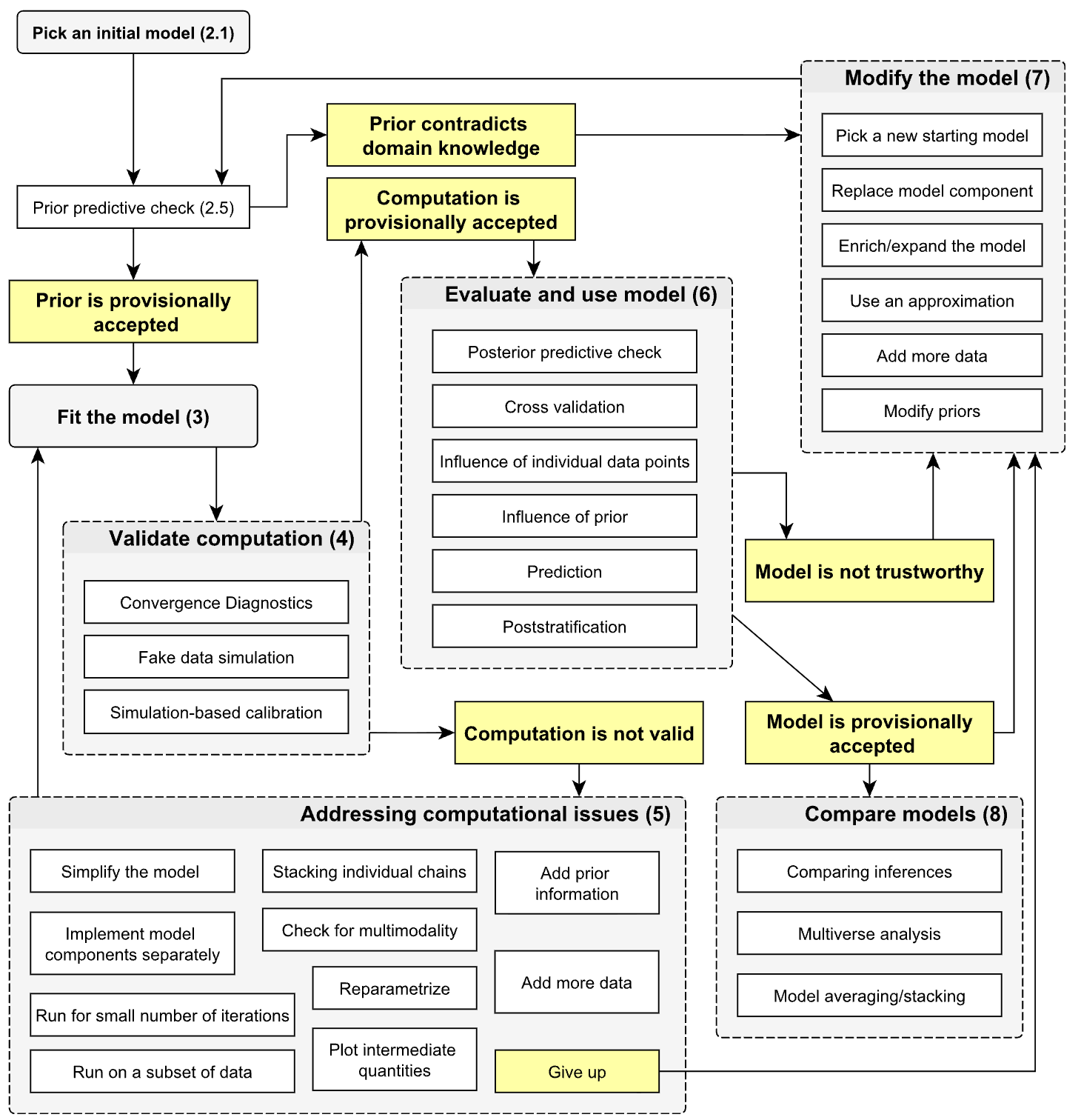
Cheap implementation makes it easier to propose another model. Acquiring evidence that the model remains appropriate for the world producing its data can still be expensive.
Meanwhile, the environment keeps moving.
Leigh Van Valen’s Red Queen hypothesis concerns the evolutionary consequences of organisms adapting in relation to other organisms that are also adapting. An advantage changes the conditions faced by others, prompting further responses. Continued adaptation can therefore be necessary simply to maintain relative standing. Van Valen, “A New Evolutionary Law,” 1973.
Applied to software, this suggests a possibility: cheaper implementation could accelerate the rate at which a product’s niche changes. Competitors can introduce capabilities faster. Users can revise their expectations. Attackers can adapt their methods. New data sources of better quality can become available. Successful products can change the workflows around them, creating demands that did not previously exist.
That acceleration is a conjecture, but the feedback mechanism is familiar. A product helps reshape the environment against which its usefulness is judged.
Lehman’s work on software evolution provides a closer engineering precedent. His law of continuing change concerns systems embedded in real-world activity: they require continuing adaptation to remain satisfactory in use. The theory also treats software evolution as a process governed by feedback. These observations have a defined scope; they are not a universal biological law for every program. Lehman and Fernández, “Software Evolution.”
In this setting, specification and assurance must evolve alongside implementation. They remain essential, but they capture a developing understanding of a moving world.
A regenerated system could preserve known commitments and still prove poorly suited to emerging conditions. An existing implementation could also be deeply adapted to yesterday’s environment and become an obstacle to tomorrow’s. Ecological fitness offers no automatic argument for keeping either one.
This makes regenerability and evolvability complementary ambitions. Regenerability asks whether we can reconstruct a system without losing what matters. Evolvability asks whether we can continue discovering and responding to what matters as conditions change.
A useful extension to a regeneration experiment would therefore expose both the existing and regenerated implementations to pressures outside the established assurance suite: unfamiliar workloads, altered dependency behavior, new user practices, or changed resource limits. The aim would be to learn what each implementation retained, what each forgot, and how readily each could adapt. Such an exercise could provide evidence about adaptive capacity, although it could never exhaust the future.
The economic distinction is between producing variations and acquiring adaptations. Agents may make it inexpensive to generate many plausible implementations. Discovering which arrangements remain useful can still require observation, deployment, failure, and revision. Some of that learning depends on events that cannot be summoned on demand or compressed into a faster generation cycle.
Even agentic code can therefore be a hard-won thing. Its value depends partly on the history of selection that shaped it, and on how much of that history has become understandable and portable.
A mature software practice would cultivate the ability to regenerate while maintaining a living account of adaptation: what has been learned, where that knowledge resides, which pressures produced it, and what evidence would justify letting it go. The capacity to forget is valuable. So is the judgment to recognize what we have not yet understood well enough to forget.
References and scholarly foundations
-
Lehman, M. M. (1980). “Programs, Life Cycles, and Laws of Software Evolution.” Proceedings of the IEEE, 68(9), 1060–1076. Full text.
The strongest direct foundation for the essay’s ecological view of software. Lehman connects evolutionary pressure to the relationship between programs and their environments, explaining why software embedded in real-world activity requires continuing adaptation. His observations have a defined scope rather than applying universally to every program. -
Naur, P. (1985). “Programming as Theory Building.” Microprocessing and Microprogramming, 15(5), 253–261. Full text.
Supports the distinction between producing code and acquiring the understanding needed to develop it intelligently. It also qualifies the essay’s emphasis on code as memory: for Naur, crucial understanding resides in programmers and cannot be recovered reliably from code and documentation alone. -
Barr, E. T., Harman, M., McMinn, P., Shahbaz, M., & Yoo, S. (2015). “The Oracle Problem in Software Testing: A Survey.” IEEE Transactions on Software Engineering, 41(5), 507–525. Full text.
Supports the argument that generating an implementation and establishing its acceptability are distinct problems. The survey explains the difficulty of determining correct behavior and the continuing role of informal expectations, domain knowledge, and human judgment in assurance. -
Adami, C., Ofria, C., & Collier, T. C. (2000). “Evolution of Biological Complexity.” Proceedings of the National Academy of Sciences, 97(9), 4463–4468. Full text.
Provides a precise biological foundation for the idea that adaptations contain information about their environment. Using information theory and evolving digital organisms, the authors examine how selection accumulates environmental information in genomes. Applying this account to engineered code is an analogy, not a result established by the paper. -
Van Valen, L. (1973). “A New Evolutionary Law.” Evolutionary Theory, 1, 1–30. Full text.
The original source of the Red Queen hypothesis. It grounds the idea that adaptation by other organisms continually changes the conditions of survival. The essay extends this mechanism to software competition; the further suggestion that coding agents accelerate those dynamics remains a conjecture. -
Finlay, S., & Cooper, N. (2015). “Morphological Diversity in Tenrecs (Afrosoricida, Tenrecidae): Comparing Tenrec Skull Diversity to Their Closest Relatives.” PeerJ, 3, e927. Full text.
Grounds the Madagascar example while supplying a useful qualification. The study quantitatively examines tenrec morphology and cautions against treating their familiar reputation for adaptive radiation and convergence as a complete explanation of their diversity. -
Henderson, R. M., & Clark, K. B. (1990). “Architectural Innovation: The Reconfiguration of Existing Product Technologies and the Failure of Established Firms.” Administrative Science Quarterly, 35(1), 9–30. Full text.
Provides an organizational parallel to adaptive memory. Architectural knowledge becomes embedded in organizational structures and information-processing practices; changes in product architecture can undermine its usefulness in ways established firms struggle to recognize. This supports the essay’s concern that accumulated knowledge can become both an asset and an impediment.
Source essay
Rao, V. (2026, November 25). “Regenerable Software: A Vision for Agentic Software Engineering.” Venkatesh Rao’s Blyg, V1 draft. Original post.
The immediate interlocutor and source of the two-anchor model, regeneration debt, and regeneration testing. This is a conceptual essay rather than a peer-reviewed study.
Scope of the argument
Together, these sources support continuing software adaptation, the importance of knowledge beyond explicit artifacts, difficulties in behavioral assurance, and biological accounts of environmental information and coevolution. They do not establish that useful adaptations must remain in production code, that regeneration debt is irreducible, or that agentic coding necessarily intensifies competitive pressure. Those are the essay’s proposed questions for empirical investigation.
v2
“major: Added a diagram to illustrate the connection between the biological and software engineering themes.”
Aneesh Sathe
Join the conversation moderated
No comments yet — start the conversation.
Replying to
Thanks — your comment is awaiting moderation.