Mood-boarding for Blygger inspired by Yi Fu Tuan
fragment ↗ · snapshot of v1
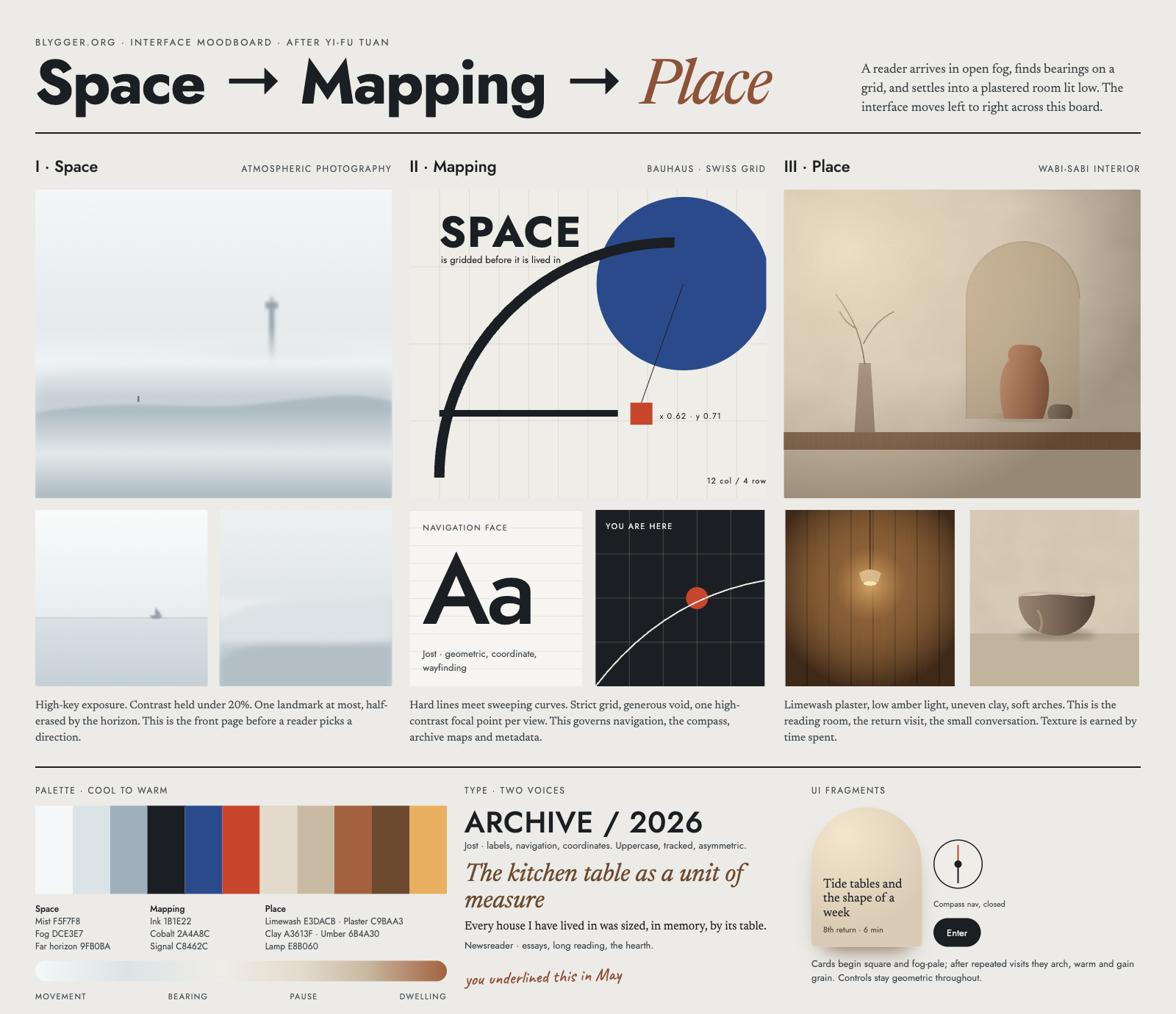
- Tuan treats spaciousness as a feeling of freedom: room to move, a horizon that invites. Space is abstract until something in it draws us closer.
- People map the world around a known core. Past its edge lies a fuzzy, half-imagined region that still orients them. Tuan calls this mythical space.
- Movement lets us experience space. Each time we stop, a location has the chance to become a place.
- The upright human body organizes space: front is the future, back is the past, up is aspiration, down is ground. Our words for value come from this posture.
- Tuan saw people swinging between the hearth (kin, locality, the familiar) and the cosmos (the wide world, strangers, universal ideas). Neither is enough on its own.
- Built form sharpens awareness. A door or gate marks the change between outside and inside, and crossing it changes how we feel.
- Tuan wrote to colleagues in long letters for years. Distance and time were part of the message: the place a letter came from and how long it travelled.
- The most moving places are often small and unremarked: a corner, a shared meal. Intimacy depends on scale; it cannot happen in a crowd.
- Place is time made visible. A sense of place builds slowly, from years of small experiences settling on each other.
- Topophilia is the affective bond between people and place. It grows through repeated, ordinary contact more than through spectacle.